
Decarbonization does not necessarily kill Growth
Stop saying climate policies hurt the economy

There is a widespread belief (held by many policymakers, business leaders, and even the president of the world’s largest economy) that reducing emissions inevitably harms economic growth. This assumption has shaped political and corporate thinking for decades. Yet the evidence shows that it is simply not true.
Globally, GDP growth has historically been strongly correlated with rising CO₂ emissions. However, this relationship is no longer universal. A growing number of countries have effectively decoupled economic growth from emissions, and in some cases the correlation has even turned negative, which means their economies continue to expand while emissions decline.
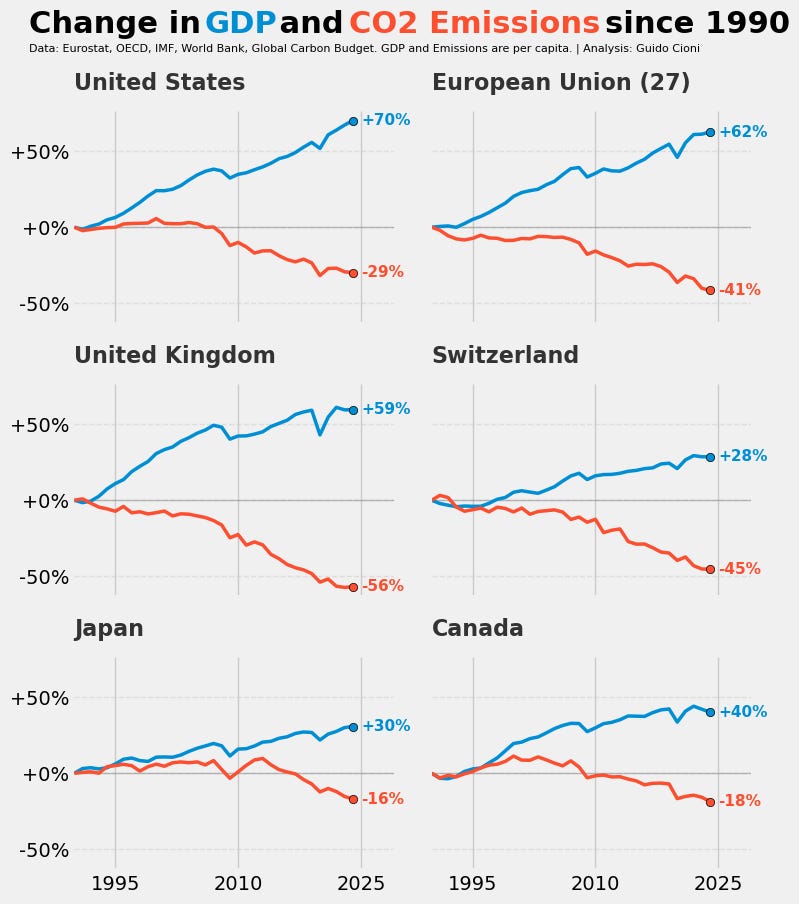
At first glance, this may seem counterintuitive. For many years, prosperity appeared to go hand in hand with higher energy consumption and greater pollution. But recent data tell a different story. In the countries shown above, GDP has steadily increased while emissions have either fallen or remained stable. The rapid deployment of renewable energy, improvements in energy efficiency, and structural shifts toward less carbon-intensive sectors have all contributed to this trend.
Importantly, these figures already account for the impact of offshoring emissions through the relocation of manufacturing to countries such as China. This means the observed decoupling cannot be explained simply by moving pollution abroad; it reflects genuine changes in how advanced economies produce and consume energy.
Of course, not all countries display this pattern. Many lower-middle- and upper-middle-income economies still show a strong positive relationship between GDP and emissions. This is particularly evident in fast-growing nations such as China and India, where rapid industrialization and rising energy demand have driven both economic expansion and increased emissions.
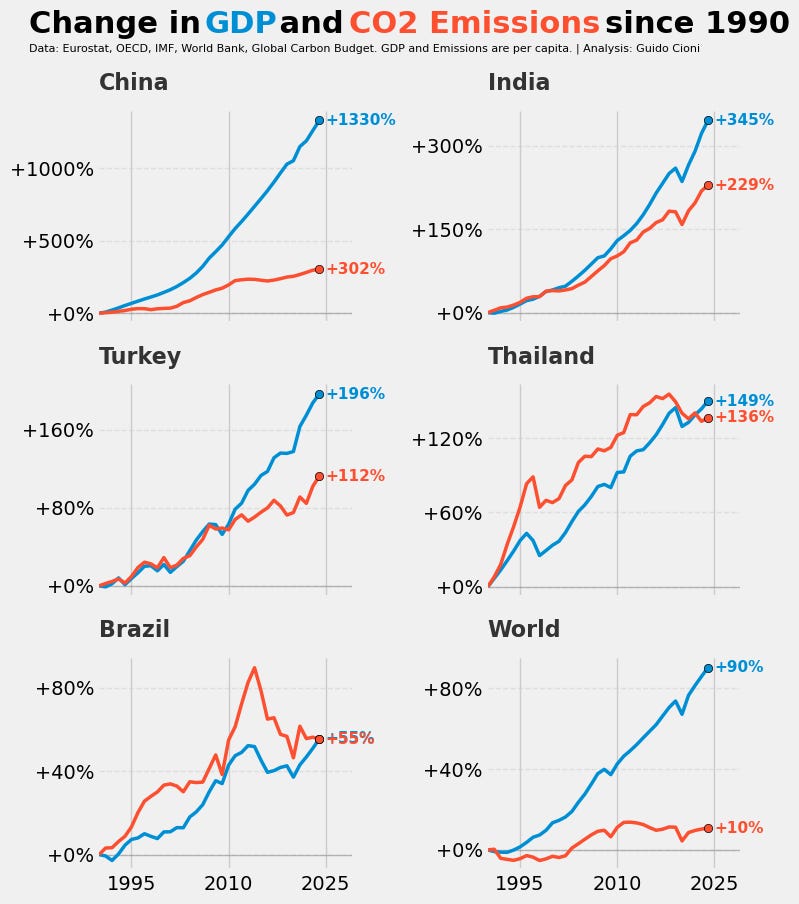
However, this contrast reinforces rather than undermines the central point: decarbonization does not inherently damage economic growth. On the contrary, it can stimulate innovation, create new industries, and strengthen long-term competitiveness. The transition to clean energy, electrification, and low-carbon infrastructure represents not an economic burden but a major opportunity for growth.
Portraying climate action as incompatible with prosperity is just misleading. The empirical evidence increasingly shows that economies can grow while emissions fall, and that pursuing decarbonization can be a powerful driver of economic development rather than an obstacle to it.